


















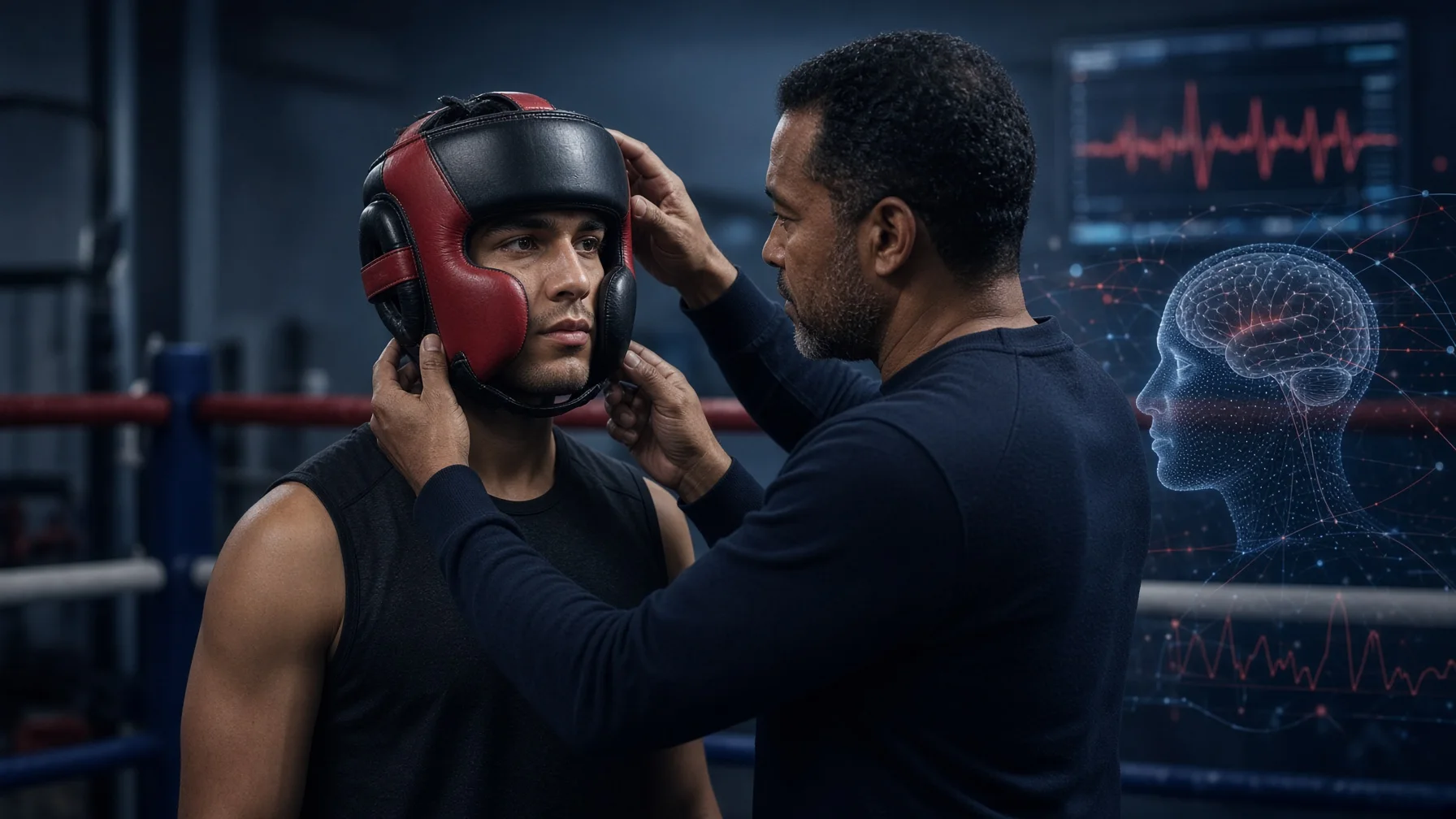
How the debate began
The claim that boxing headgear may increase concussion risk became widely known after amateur boxing rule changes in 2013 and the 2016 Rio Olympics. Comparisons of bouts with and without headguards reported differences in stoppages and observable signs associated with concussion.
Those comparisons cannot provide a simple yes-or-no answer. Scoring, bout management, boxer tactics and referee behaviour also changed, so the observed differences cannot be attributed to headgear alone.
What headgear is known to do
The clearest benefit is protection against facial and scalp cuts and other superficial injuries. Laboratory tests also show that some approved headguards can reduce linear and rotational acceleration in selected frontal and side impacts.
Concussion, however, can result from rapid movement and rotation of the brain. A poorly fitted guard, an exposed jaw or restricted peripheral vision may produce different results in the ring than in a laboratory. Wearing headgear does not make hard sparring or repeated head impacts safe.
Does it actually increase concussion risk?
Current evidence does not justify a universal claim that headgear increases concussion risk. Some observational data found fewer head-contact stoppages in bouts without headguards, while other work reported more knockouts, technical knockouts and skin splits after the rule change. Systematic reviews and the Association of Ringside Physicians note that human evidence remains limited and inconsistent.
A larger target area, reduced peripheral vision and “risk compensation”—taking greater risks because equipment feels protective—are plausible explanations. They are not proof that headgear causes more concussions in every boxer.
Safety rules for boxers and coaches
• Follow the current equipment rules of the event and sanctioning body.• Use approved equipment and check that it fits without shifting.• Do not treat headgear as permission for harder sparring.• Manage sparring intensity, cumulative head impacts and recovery time.• Stop immediately for headache, dizziness, confusion, memory problems, nausea, or sensitivity to light or sound, and seek medical assessment.• Do not return the same day after a suspected concussion; follow a supervised, stepwise return.
Bottom line
Boxing headgear is useful for reducing cuts and some facial injuries, but it is not a brain shield. Evidence is also insufficient to say that it generally increases concussion risk. Proper fit, sensible sparring, early symptom recognition and medical management matter more than relying on equipment alone.
Notice: This article is general information and does not replace medical diagnosis or treatment.
References
• Association of Ringside Physicians: Headguard use in combat sports• Consensus statement on concussion management in combat sports• Boxing headguard performance in punch-machine tests• Systematic review of protective headgear in Olympic boxing
 United States